Someone got hurt at your plant. The adrenaline is high, the facts are incomplete, and the clock is running. This guide walks through the first 48 hours: caring for the employee and securing the scene, deciding whether the case is OSHA recordable or reportable, the 8-hour and 24-hour reporting rules, completing the OSHA 300 log and 301 form, running an investigation that finds real causes, and connecting it all to your ISO 45001 system.
Someone Got Hurt. Start Here.
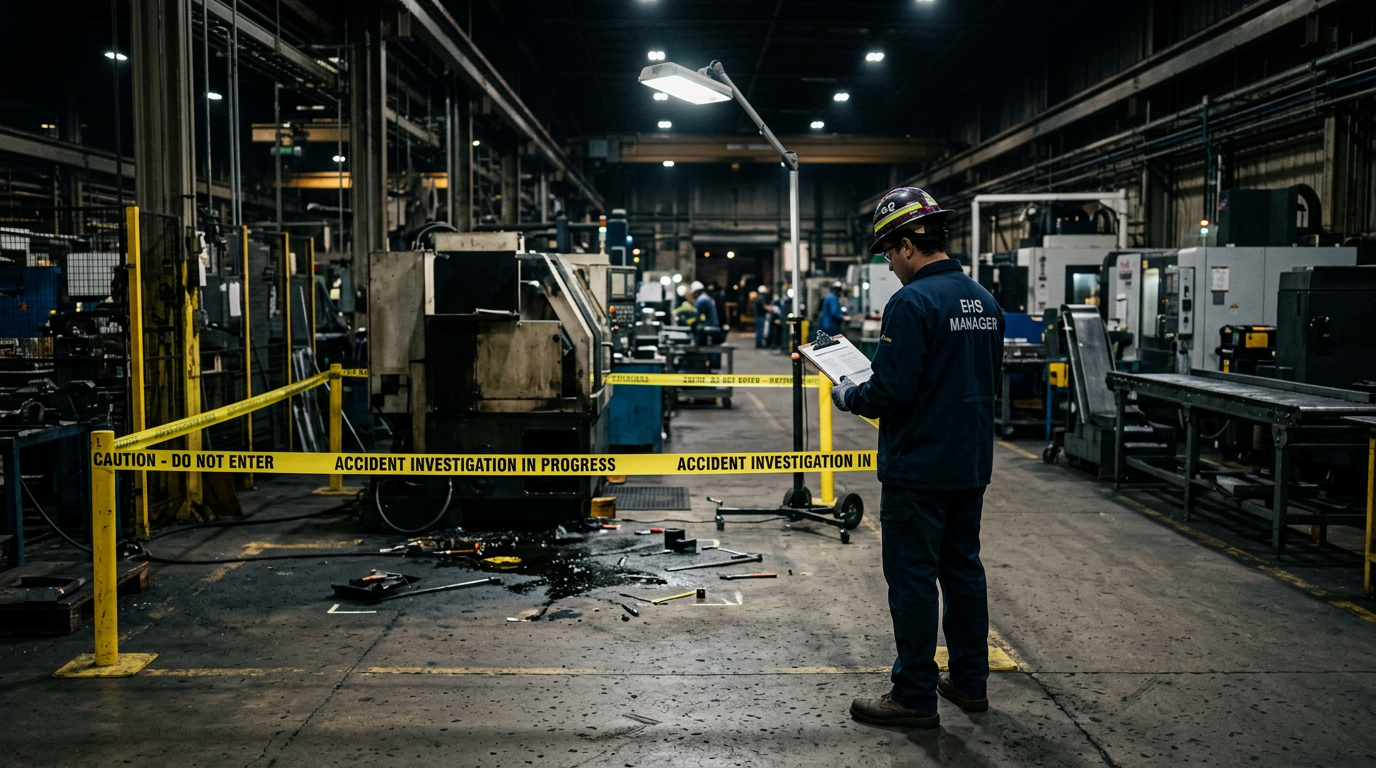
The first priority isn't paperwork. It's the injured person. Make sure they get appropriate care, whether that's first aid on site or emergency medical treatment. Then make the area safe so nobody else gets hurt, and preserve the scene as far as safety allows for the investigation.
Once the immediate situation is under control, the next 48 hours determine whether this becomes a learning event or a second failure during the paperwork. This guide covers the federal OSHA requirements. If you're in a state with its own OSHA-approved state plan, requirements may differ, so confirm the rules that apply to you.
Step 1: Is It Reportable? Check the Clock
Some events must be reported directly to OSHA, not just recorded. Under federal rules (29 CFR 1904.39), you must report a work-related fatality within 8 hours of learning about it. You must report a work-related in-patient hospitalization, an amputation, or the loss of an eye within 24 hours.
Reports can be made by phone to the nearest OSHA area office, to OSHA's central hotline, or online. Know how you'll report before you need to. Put the numbers and the process in your emergency plan.
A recordable and a reportable are different things. Many recordable cases don't need to be reported to OSHA directly, but every reportable case is also recordable.
Step 2: Is It Recordable?
Under 29 CFR 1904, a case is generally recordable if it is work-related, is a new case, and meets one or more general recording criteria: death, days away from work, restricted work or transfer to another job, medical treatment beyond first aid, loss of consciousness, or a significant injury or illness diagnosed by a physician or other licensed health care professional.
The distinction between first aid and medical treatment trips up many employers. OSHA defines first aid by a specific list, including things like non-prescription medication at non-prescription strength, cleaning and bandaging wounds, hot or cold therapy, and non-rigid means of support. Treatment beyond that list, like prescription medication, sutures, or rigid splints for immobilization, generally makes the case recordable.
When the call is unclear, OSHA's recordkeeping regulations and interpretations are the authority. Document your reasoning either way.
Step 3: Record It Correctly
Recordable cases must be entered on the OSHA 300 log and documented on an OSHA 301 incident report, or an equivalent form, within seven calendar days of receiving information that a recordable case occurred.
The annual summary, OSHA Form 300A, must be certified by a company executive and posted in the workplace from February 1 to April 30 each year. Certain establishments, depending on size and industry, must also submit injury and illness data to OSHA electronically each year. Check whether your establishment is covered.
Keep the records for five years following the end of the calendar year they cover. Also note that some small employers and some industries are partially exempt from routine recordkeeping, but all employers must still report severe injuries.
Step 4: Investigate for Causes, Not Blame
A good investigation starts quickly, while memories are fresh and the scene is intact. Gather facts: interview the injured employee when they're able, talk to witnesses separately, take photos, and collect records like training, maintenance, and procedures.
Then dig past the obvious. "Employee didn't follow procedure" is a starting point, not a root cause. Ask why. Was the procedure realistic? Was the employee trained? Was there production pressure? Was the guard removed because it made the job harder? Tools like five whys or a fishbone diagram help teams look at equipment, methods, environment, training, and management factors, not just the individual.
Investigations that end with blame teach people to hide incidents. Investigations that find system causes teach people to report them.
Step 5: Fix It Using the Hierarchy of Controls
Corrective actions should follow the hierarchy of controls: eliminate the hazard, substitute something less hazardous, use engineering controls like guards and interlocks, then administrative controls like procedures and training, and finally personal protective equipment. Retraining and reminders are the weakest controls. Use them, but not alone.
Check whether the same hazard exists elsewhere in the plant, on similar machines, other shifts, or other sites. Then verify the fix works.
Step 6: Communicate Without Creating Liability Theater
Leadership will want answers. Give them facts, not speculation: what happened, the employee's status, immediate actions taken, reporting status, and when the investigation will conclude. Avoid assigning blame before the investigation is complete.
Communicate with the workforce too. Explain what happened, in appropriate detail, and what's being done about it. Visible action after an incident builds trust in the safety system.
Connect It to Your ISO 45001 System
If you're certified to ISO 45001, or working toward it, the incident process is part of your management system. Clause 10.2 requires you to react to incidents, investigate them with worker participation, determine causes, take corrective action, review risk assessments, and keep documented evidence. Handled well, a serious incident becomes evidence that your system works. Handled poorly, it becomes an audit finding on top of a safety failure.
How We Help
ComplianceFortress, our EHS brand, helps manufacturers respond to incidents, build investigation capability, strengthen OSHA recordkeeping, and connect it all to ISO 45001. If you just had an OSHA recordable, see our page on this situation, or tell us what's going on.
Sounds like your situation?
“We just had an OSHA recordable”
See exactly how we approach this situation, what you'll have at the end, and request a Situation Review with our team.
Frequently Asked Questions
What makes an injury OSHA recordable?
Under 29 CFR 1904, a work-related injury or illness is generally recordable if it results in death, days away from work, restricted work or job transfer, medical treatment beyond first aid, loss of consciousness, or a significant injury or illness diagnosed by a physician or other licensed health care professional.
When do I have to report an injury to OSHA?
Under federal OSHA rules, a work-related fatality must be reported within 8 hours. An in-patient hospitalization, amputation, or loss of an eye must be reported within 24 hours. State-plan states may have different requirements, so confirm the rules that apply to you.
How long do I have to record a case on the OSHA 300 log?
Recordable cases must be entered on the OSHA 300 log and documented on a 301 incident report or equivalent within seven calendar days of receiving information that a recordable case occurred.
Is a recordable the same as a reportable?
No. A recordable goes on your OSHA 300 log. A reportable is a severe event such as a fatality, in-patient hospitalization, amputation, or loss of an eye that must also be reported directly to OSHA within the required time.