Three standards, three manuals, three audit schedules, three management reviews — and one small team trying to keep all of it alive. ISO 9001, ISO 14001 and ISO 45001 share the same high-level structure, which means most of that duplication is optional. This guide shows what an integrated management system looks like, what to combine first, what must stay separate, and how to integrate without disrupting your certifications.
Three Standards, Three Systems, One Tired Team
It usually happens gradually. ISO 9001 came first, because a customer required it. ISO 14001 arrived a few years later, maybe with a different consultant. ISO 45001 followed after a safety push. Each one got its own manual, its own procedures, its own audit schedule, and its own management review.
Now a small team spends a large part of the year maintaining three parallel systems. Document control is done three ways. Internal audits happen three times. Leadership sits through three management reviews that cover much of the same ground. And the floor gets three sets of instructions that don't always agree.
Most of that duplication is optional.
Why Integration Is Possible: The Shared Structure
Modern ISO management system standards, including ISO 9001, ISO 14001, and ISO 45001, are built on a common high-level structure, originally known as Annex SL and now referred to as the harmonized structure. They share the same ten clause headings: scope, normative references, terms, context of the organization, leadership, planning, support, operation, performance evaluation, and improvement.
Many requirements within those clauses are nearly identical across the three standards: understanding the organization's context and interested parties, leadership commitment, risks and opportunities, competence and awareness, communication, documented information, internal audit, management review, nonconformity and corrective action, and continual improvement.
When the requirements are the same, running three separate processes to meet them is waste.
What to Combine
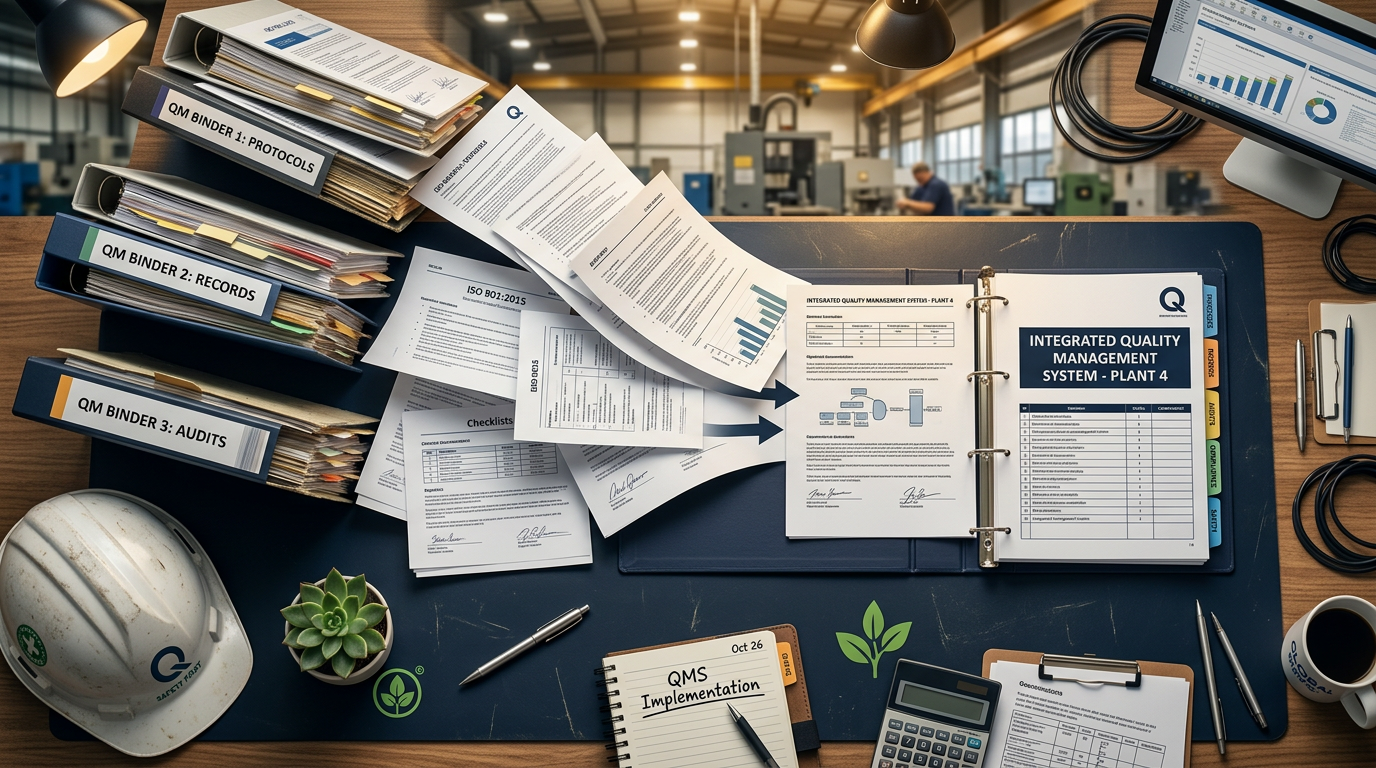
An integrated management system (IMS) combines the shared processes into one. The usual candidates include these.
One policy, or a single integrated policy statement covering quality, environment, and health and safety commitments.
One process for context, interested parties, and risks and opportunities, with discipline-specific inputs.
One document control and records process.
One competence, training, and awareness process.
One internal audit program, with audits that cover all three standards for each process or area.
One nonconformity, incident, and corrective action process.
One management review, with inputs from all three disciplines.
One set of objectives, organized by discipline but reviewed together.
What Stays Distinct
Integration doesn't erase the differences between quality, environment, and safety. Some requirements are unique and need their own methods and expertise.
ISO 14001 requires you to identify environmental aspects and impacts, determine compliance obligations, and control operations that affect the environment.
ISO 45001 requires hazard identification, OHS risk assessment, the hierarchy of controls, and consultation and participation of workers, a requirement with no direct equivalent in ISO 9001.
ISO 9001 focuses on product and service conformity and customer satisfaction.
The goal is one system with specialized modules, not one blended process that loses the discipline-specific rigor.
The Benefits You Can Actually Expect
Less duplication: one procedure where you had three, one audit program, one management review.
Fewer contradictions: when document control and corrective action work the same way everywhere, the floor gets one message.
Better decisions: leadership sees quality, environmental, and safety performance side by side, and can see trade-offs and connections. Many root causes, like poor training or weak change management, affect all three.
Potentially fewer audit days: many certification bodies offer combined audits, which can reduce total audit time and disruption compared with three separate audits. How much depends on your certification body and on how integrated your system genuinely is.
How to Integrate Without Disrupting Certification
Integration is a change to how you run the system, not a new certification, so you can do it in phases.
Start by mapping. Put the three systems' procedures side by side against the shared clause structure, and find where they overlap and conflict.
Integrate the easiest shared processes first, usually document control, records, and corrective action, where the requirements are most similar.
Move to integrated internal audits. Train auditors across all three standards, and audit by process or area instead of by standard.
Combine management review. Build one agenda with discipline-specific inputs and one set of outputs.
Talk to your certification body about combined audits and align surveillance dates if needed.
Throughout, keep meeting every standard's requirements. Your auditors will check that nothing fell through the cracks during the transition.
Common Integration Mistakes
Merging everything into one giant manual that nobody can use. Integration should simplify, not create a thicker binder.
Losing worker participation. ISO 45001's consultation and participation requirements need deliberate attention, not a footnote.
Training auditors in only one standard. Integrated audits need auditors who can see quality, environmental, and safety issues in the same walk.
Doing it all at once. A phased approach keeps the system stable and the team sane.
How We Help
Integration is one of the places where an ecosystem approach helps most. Exceleor handles the quality management side while ComplianceFortress brings EHS depth, and both work from one plan. We map your current systems, design the integrated structure, train your auditors across all three standards, and verify the result before your next audit.
If you're running three standards separately, see our page on running three standards separately, or tell us what's going on.
Sounds like your situation?
“Running 9001, 14001 and 45001 as three separate systems”
See exactly how we approach this situation, what you'll have at the end, and request a Situation Review with our team.
Frequently Asked Questions
What is an integrated management system?
An integrated management system (IMS) combines the requirements of several standards, such as ISO 9001 for quality, ISO 14001 for environment, and ISO 45001 for health and safety, into one set of processes, documents, audits, and management reviews instead of running each one separately.
Can ISO 9001, 14001 and 45001 be audited together?
Yes. Many certification bodies offer combined or integrated audits. Combined audits can reduce total audit days and disruption compared with three separate audits, though the exact reduction depends on your certification body and how integrated your system really is.
What stays separate in an integrated system?
The discipline-specific content stays separate: environmental aspects and impacts, OHS hazard identification and worker participation, and product quality controls. The shared processes such as document control, internal audit, corrective action, competence, and management review are combined.
Do we lose our certifications while integrating?
No. Integration is a change to how you run the system, not a new certification. Plan the change, tell your certification body, and keep meeting every standard's requirements throughout the transition.