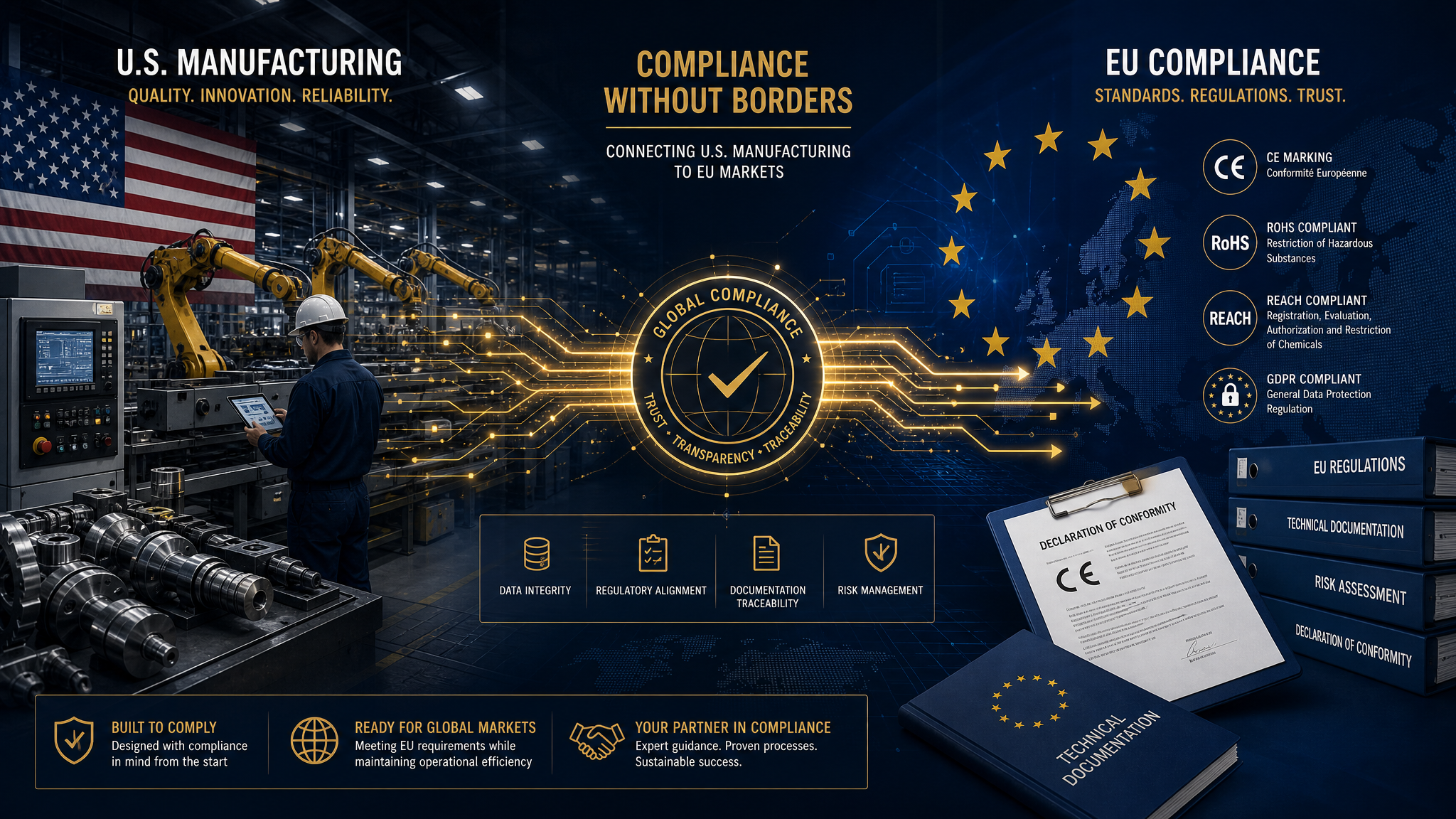
If you sell products into Europe that contain AI — machine vision systems, smart sensors, autonomous robots, AI-powered quality inspection — the EU AI Act applies to you regardless of where you are headquartered. With enforcement beginning in phases through 2027, US manufacturers face a compliance cliff. We explain the 4 risk tiers, which manufacturing AI applications fall into "high risk" (hint: most of them), the documentation requirements that mirror ISO 42001, and the practical steps to achieve compliance without disrupting your operations. The penalties for non-compliance start at €35 million or 7% of global revenue.
What US Manufacturers Need to Know
The EU AI Act applies to US manufacturers who place AI-enabled products on the European market or whose AI systems affect people within the EU. This extraterritorial reach means that US manufacturers exporting to Europe must understand and comply with EU AI Act requirements regardless of where their operations are based.
The Act classifies AI systems by risk level: unacceptable risk (banned), high risk (requiring conformity assessment), limited risk (requiring transparency), and minimal risk (no specific requirements). Manufacturing AI applications — particularly those used in quality inspection, safety monitoring, and worker management — may fall into the high-risk category.
High-Risk AI in Manufacturing
The EU AI Act identifies specific high-risk categories relevant to manufacturing including AI systems used as safety components of products, AI used in employment and worker management, and AI embedded in products covered by EU harmonization legislation. Quality inspection AI that determines product conformity, predictive systems that influence safety-critical maintenance decisions, and worker monitoring systems all potentially qualify as high-risk.
High-risk AI systems must meet requirements for risk management, data governance, technical documentation, record-keeping, transparency, human oversight, accuracy, robustness, and cybersecurity. These requirements add significant compliance obligations but align closely with ISO 42001 implementation.
Compliance Strategy
US manufacturers can prepare for EU AI Act compliance through three parallel efforts. First, inventory all AI systems and classify them according to the Act risk categories. Second, implement ISO 42001 as your AI governance framework — its requirements closely align with EU AI Act obligations for high-risk systems. Third, establish conformity assessment processes for high-risk AI systems.
ISO 42001 provides the most efficient compliance pathway because it addresses the systematic management requirements that the EU AI Act mandates for high-risk systems. Manufacturers who have already implemented ISO 42001 will find that EU AI Act compliance requires minimal additional effort.
Timeline and Preparation
The EU AI Act entered into force in 2025 with phased implementation. High-risk AI requirements become fully enforceable by 2027. US manufacturers exporting to Europe should begin compliance preparation now to meet these deadlines without disrupting ongoing operations.
Start with AI system inventory and risk classification. Implement ISO 42001 for governance framework. Establish performance monitoring and human oversight for high-risk systems. Build documentation and record-keeping processes that demonstrate conformity. OPZ360 helps manufacturers navigate these requirements within the context of their existing management systems.