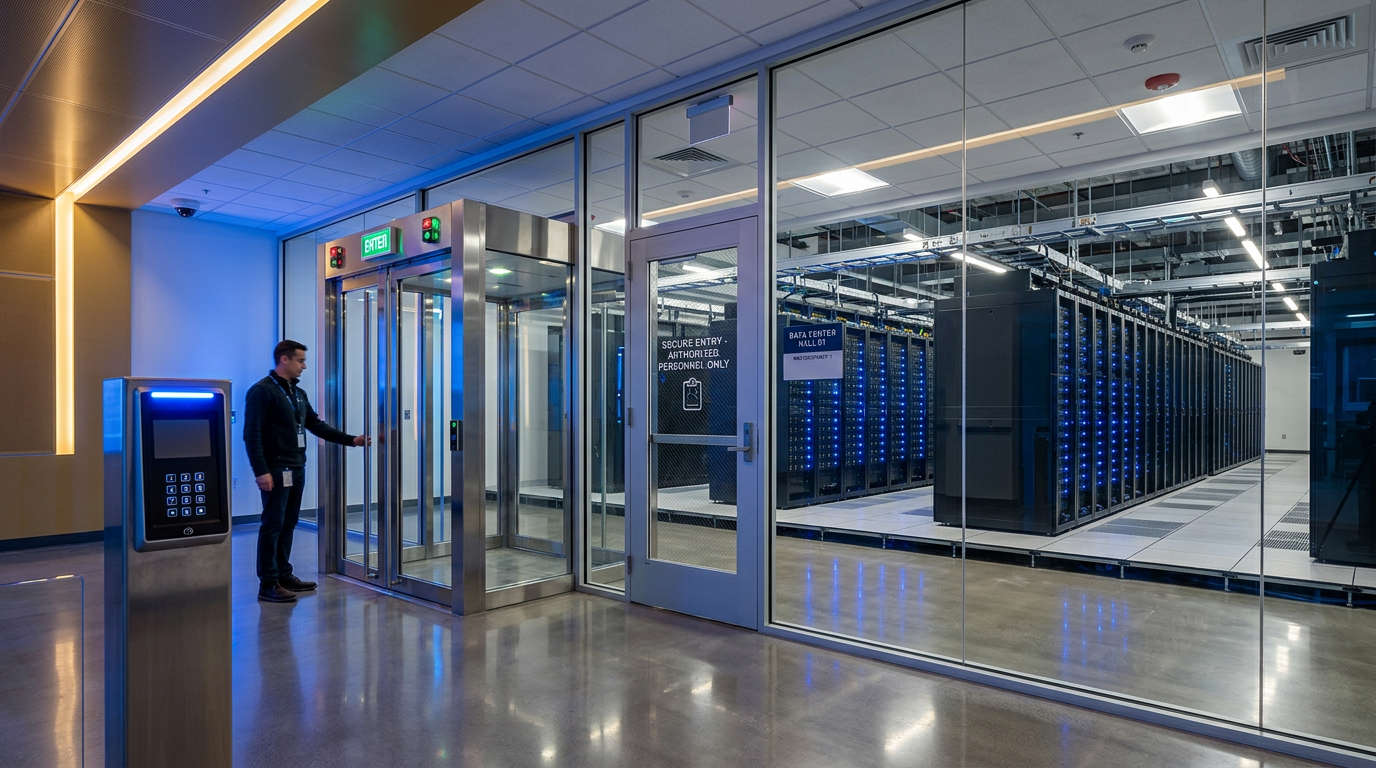

Most people picture a data center security audit as a walk past badge readers, cameras, and locked cages. Those controls matter, but they are the visible end of a chain of processes: who approves access, how changes are made, how maintenance is scheduled, how incidents are handled, and how vendors are supervised. When one of those processes breaks, the lock on the door doesn't help. This article explains what a security audit really tests in a data center, and why the lasting benefit is a set of processes that work the same way every time.
The Lock Is the Last Step, Not the First
Walk into most data centers and security is easy to see: fences, mantraps, badge readers, biometric scanners, cameras, locked cages. It's natural to think a security audit is a check that all of that hardware is in place and working.
But every one of those controls sits at the end of a process. A badge reader only lets in the people on its list, and someone decided who goes on that list. A camera only helps if someone reviews the footage and keeps it long enough to matter. A locked cage only protects equipment if the keys and combinations are controlled when staff and vendors change.
That's why a well-run security audit spends as much time on the processes behind the controls as on the controls themselves. Most security failures in data centers don't come from a broken lock. They come from a process that quietly stopped being followed.
Benefit 1: Access That Matches Reality
Access management is the process auditors test most, because it drifts the fastest. People join, change roles, and leave. Contractors come for a project and never formally leave. Customers add and remove their own staff.
An audit follows the full access lifecycle: request, approval, provisioning, periodic review, and removal. The auditor samples real people and checks that each step happened and left a record. Two questions get asked a lot: "Show me who approved this person's access" and "Show me when access was removed for someone who left."
The benefit isn't only a cleaner badge list. You end up with an access process that keeps itself accurate, where reviews actually remove access and leavers are caught on their last day, not at the next audit.
Benefit 2: Changes That Don't Surprise Anyone
In a data center, change is constant: new racks, power work, cooling adjustments, network changes, firmware updates. Each change is also a risk to security and availability. An unplanned change can open a door that should stay closed, take down redundancy, or leave a monitoring system blind.
Auditing change management means checking that changes are requested, assessed for risk, approved by the right people, scheduled, carried out as planned, and reviewed afterward. Emergency changes get special attention, because that's where shortcuts become habits.
The process benefit: a change process strong enough that security and uptime risk is considered before the work starts, not discovered after something breaks.
Benefit 3: Maintenance and Vendors Under Control
Much of the work inside a data center is done by people who don't work for you: generator and UPS technicians, cooling contractors, fire suppression vendors, carriers, and customers' own engineers. Each one needs access, and each one can create risk.
An audit looks at how maintenance is scheduled against manufacturer requirements, how vendor visits are authorized and escorted, how work is recorded, and whether supplier security requirements in contracts are ever checked in practice.
The benefit is a facility where outside work follows the same rules every time. Maintenance is done on schedule, vendors are supervised, and there's a record showing both.
Benefit 4: Incidents That Make You Stronger
Every data center has incidents: a door propped open, a failed badge, a temperature alarm, a tailgating attempt, a power event. What separates a mature facility from an immature one isn't the absence of incidents. It's what happens after.
Auditors review how incidents are detected, reported, classified, investigated, and closed, and whether lessons learned actually change anything. A common finding is an incident log full of entries with no root cause and no follow-up action.
When the incident process works, each event makes the facility a little harder to compromise. That's a benefit no piece of hardware can provide.
Benefit 5: Evidence Your Customers Will Ask For
Colocation customers, cloud tenants, and enterprise users increasingly ask for proof, not promises. Security questionnaires, contract clauses, and customer audits all want the same thing: evidence that controls are designed properly and working over time.
An independent audit tells you before your customers do whether your evidence holds up. It also turns scattered records such as visitor logs, change tickets, access reviews, and maintenance reports into an organized body of evidence you can present with confidence.
That shortens customer onboarding, reduces the effort of answering questionnaires, and puts you in a much stronger position for ISO 27001 certification audits or SOC 2 examinations.
Benefit 6: Fewer Single Points of Failure in People
Data centers are designed to remove single points of failure in power, cooling, and network. Processes often still have them. One facilities manager knows how the access system is configured. One engineer knows the generator test routine. One shift lead knows which vendor to call.
A process-focused audit exposes those dependencies. When the auditor asks "what happens if this person is out?" and nobody has a documented answer, that's a finding worth more than any camera placement.
The fix is documented, trained processes that any qualified person can follow. That's the same principle of redundancy the facility was built on, applied to how it's run.
Security and Availability Are the Same Conversation
In a data center, security and availability can't be separated. A poorly controlled change can cause an outage. An unsupervised vendor can create a security incident. A missed maintenance task can take down redundancy that both security systems and customers depend on.
That's why we audit data centers as a connected system of processes, not a checklist of devices. We draw on ISO/IEC 27001 for information security controls, ISO/IEC 20000-1 for service management processes, and the specific requirements in your customer contracts.
We've spent years on both sides of the audit table as implementers and as third-party auditors, so we know the difference between a process that looks good on paper and one that holds up under sampling.
Where to Start
If you haven't audited your facility against its processes recently, start with three questions:
1. Could you show an auditor, for any person on your access list, who approved their access and when it was last reviewed? 2. Could you show that every change and maintenance activity in the last quarter was approved and recorded? 3. Could you show what changed as a result of your last three incidents?
If any answer is "not easily," an independent data center security audit will pay for itself in clarity alone. Tell us about your facility at [email protected] or through our contact page, and we'll talk through what an audit would cover.
Related Service
Data Center Audits
Independent data center security audits that look past the locks and cameras to the processes that keep your facility secure, available, and audit-ready.
Frequently Asked Questions
What is a data center security audit?
A data center security audit is an independent review of the physical, environmental, and operational controls that protect a facility and the systems inside it. A good audit tests both whether controls exist and whether the processes behind them, such as access approval, change management, maintenance, and incident response, are followed consistently and produce evidence.
What are the benefits of a data center security audit?
Beyond finding control gaps, an audit shows where processes depend on individuals instead of procedures, where evidence is missing, and where security and uptime risks overlap. The result is fewer surprises in customer and certification audits, faster onboarding of customers who ask for assurance, and processes that work the same way on every shift.
How often should a data center be audited?
Most organizations audit at least annually, often aligned with their ISO 27001 or ISO 20000-1 internal audit program, customer contract requirements, or attestation cycle. Higher-risk processes such as access management and change management are often audited more frequently, and after any major change to the facility or operating model.
Which standards apply to data center security audits?
ISO/IEC 27001 is the most common framework, particularly its physical, technological, and supplier controls. ISO/IEC 20000-1 covers the service management processes that keep a facility running, and many operators also prepare for SOC 2 examinations or customer-specific requirements. We audit against the framework and contract requirements that apply to your facility.