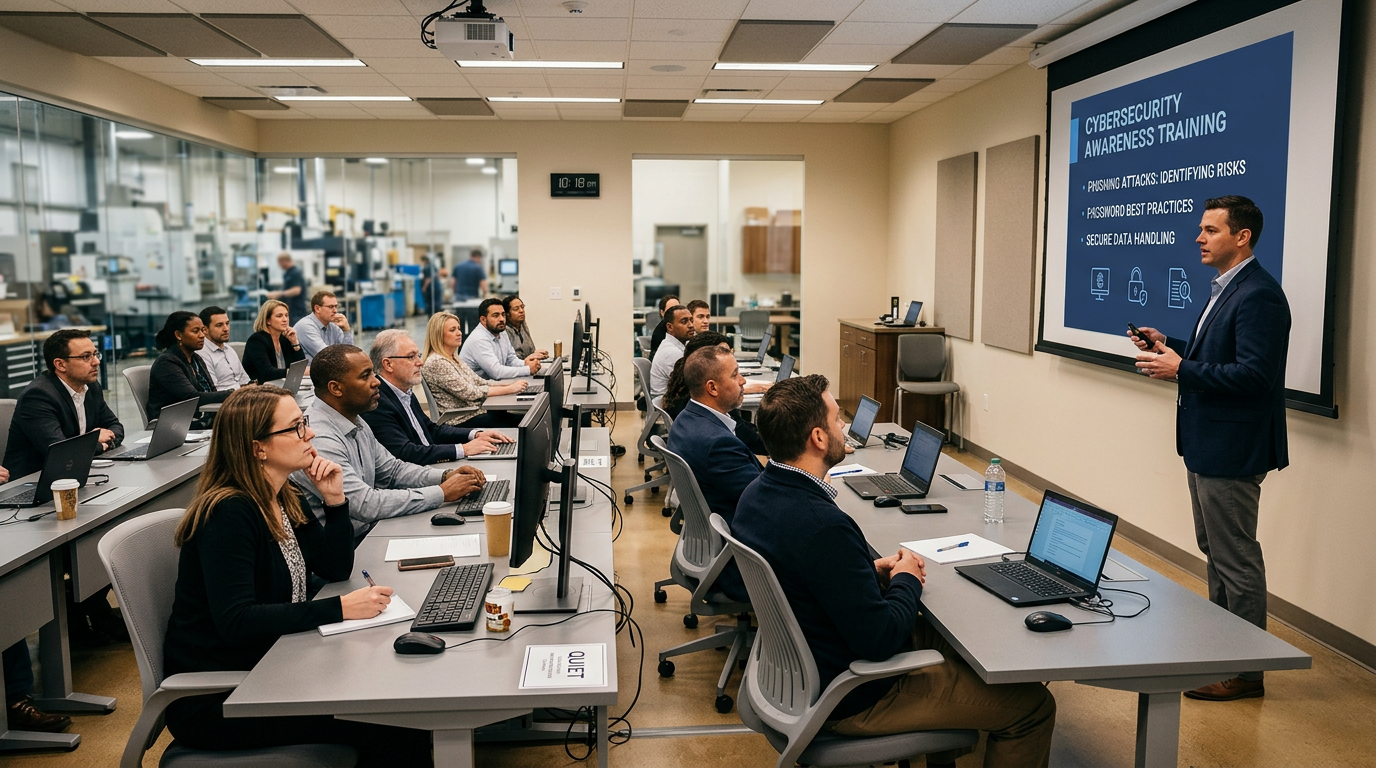
The most sophisticated firewall in the world will not stop an employee who clicks a phishing link or plugs an unknown USB drive into a controls PC. In manufacturing — where IT and OT networks increasingly connect — human error is the leading cause of security incidents. Yet most manufacturers treat security awareness as an annual video nobody watches. We explain how to build a cybersecurity training program that actually changes behavior: how to tailor training to manufacturing-specific threats like OT intrusion and supply-chain compromise, how to run phishing simulations that teach instead of shame, how to satisfy the awareness requirements in ISO 27001, CMMC, and NIST 800-171, and how to measure whether your training is working. Because in a ransomware era, an unprepared workforce is an unlocked door.
The Human Attack Surface
The most sophisticated firewall in the world will not stop an employee who clicks a convincing phishing link, reuses a password, or plugs an unknown USB drive into a controls PC. Across every framework and every industry, human error remains the leading cause of security incidents — and manufacturing is especially exposed because IT and operational technology networks increasingly connect. A single compromised credential or infected device can jump from the front office to the plant floor, and in an OT environment the consequences include stopped production and safety risk, not just data loss.
Yet most manufacturers treat security awareness as an annual video that employees click through while doing something else. That approach satisfies a checkbox and changes no behavior. In a ransomware era, an untrained workforce is an unlocked door — and attackers know it. Real awareness training treats people as the primary defense they actually are.
Training for Manufacturing-Specific Threats
Generic security awareness training misses the threats that matter most in a plant. Manufacturing employees need training tailored to their environment: OT-specific risks like unauthorized devices on control networks, the dangers of USB media on production equipment, social engineering aimed at plant staff, and supply-chain compromise where an attacker reaches you through a trusted supplier or a software update. Front-office staff, engineers, and floor operators face different threats and need different, relevant examples.
Effective training uses realistic scenarios drawn from actual manufacturing incidents — the maintenance contractor's laptop, the emailed invoice that reroutes a payment, the "firmware update" that is anything but. When training reflects the threats employees actually encounter in their specific roles, they recognize and stop attacks instead of forgetting a generic slideshow the moment it ends.
Phishing Simulations That Teach
Phishing simulations are among the most effective awareness tools — when they are run to teach rather than to shame. The goal is not to catch employees and punish them; it is to build recognition through safe, repeated practice. Send realistic simulated phishing emails, and when someone clicks, immediately deliver short, constructive coaching that explains the warning signs they missed. Over time, click rates fall and reporting rates rise.
The metric that matters most is not the click rate but the reporting rate — how many employees recognize and report a suspicious message. A workforce that reports phishing turns every employee into a sensor for your security team. Run simulations regularly, vary the scenarios, and track the trend. A punitive program drives incidents underground; a supportive one builds a genuine human firewall that improves measurably quarter over quarter.
Satisfying ISO 27001, CMMC, and NIST 800-171
Security awareness training is not optional under the frameworks manufacturers increasingly must meet. ISO 27001 requires awareness of the information security policy and each person's role in it. CMMC and NIST SP 800-171 explicitly require security awareness training, including recognizing and reporting threats, with records to prove it. A well-designed program satisfies all three at once while genuinely reducing risk — the compliance requirement and the security outcome point in the same direction.
The key is to demonstrate not just that training happened but that it produced competence and changed behavior — tracked completion, simulation results, and reporting trends together tell that story. AppliedGuidance builds manufacturing cybersecurity awareness programs that meet the awareness requirements across ISO 27001, CMMC, and NIST 800-171 while measurably strengthening the human layer of defense. Because passing an audit means little if your weakest link is still an unlocked door.