Most manufacturers assume that shorter lead times require capital investment. In reality, the biggest gains come from eliminating the waiting, rework, and handoffs that value stream mapping makes visible. VSM is the Lean tool that shows you the difference between the time your product spends being worked on and the time it spends waiting — and the ratio is almost always shocking. We walk through how to map your current state honestly, how to identify the eight wastes hiding between your process steps, how to design a future-state map that removes bottlenecks, and how to build an implementation plan that turns the map into measurable lead-time and inventory reductions. This is how QMSLean helps manufacturers free up cash and capacity without spending on new machines.
The Lead-Time Myth
Ask most manufacturers how to shorten lead time and they will point to faster machines, more equipment, or additional shifts — all of which cost capital. But when you actually map how long a product spends in your facility versus how long it spends being worked on, the truth is startling: value-added time is often less than five percent of total lead time. The other ninety-five percent is waiting — in queues, in inventory, between handoffs, waiting for approvals, waiting for the next process to be ready.
That is the central insight of value stream mapping. The biggest lead-time reductions almost never come from making the value-added steps faster. They come from attacking the enormous waiting time between steps — and eliminating waiting rarely requires buying anything. It requires seeing the waste clearly, which is exactly what VSM makes possible.
Mapping the Current State Honestly
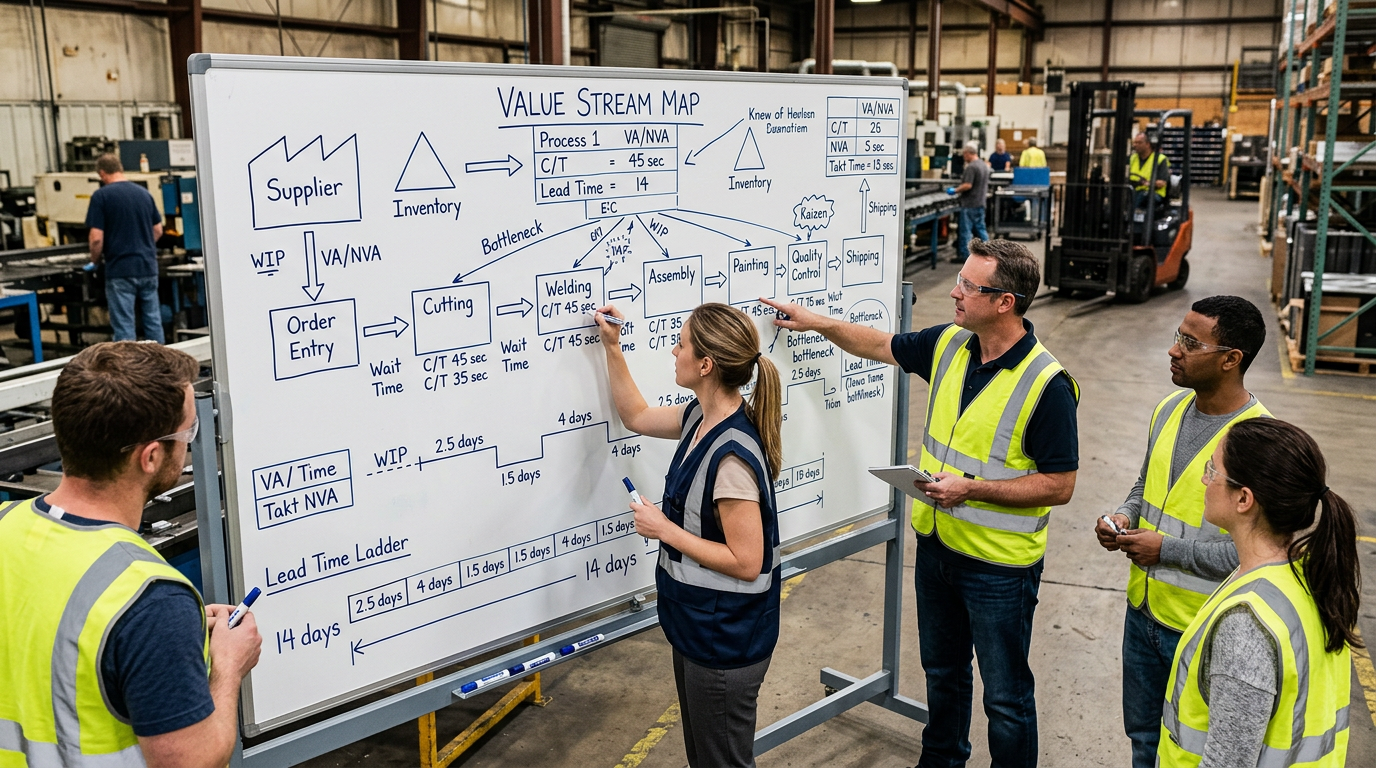
A value stream map traces a product family from raw material to shipment, capturing both the material flow and the information flow that triggers each step. The discipline that makes VSM powerful is honesty: you walk the actual process, measure actual cycle times, actual changeover times, actual inventory levels, and actual wait times — not the numbers people wish were true. You record where inventory piles up, where information gets delayed, and where the process stops and starts.
The key metric that emerges is the ratio of value-added time to total lead time. When a team sees that a part they thought took two days actually spends nine days in the building, with only a few hours of real work, the case for change makes itself. Map at a level of detail that reveals the waiting, and resist the urge to map the idealized process — you can only improve the process you actually have.
Finding the Eight Wastes
With the current-state map in hand, the wastes become visible. Lean identifies eight: overproduction, waiting, transportation, over-processing, inventory, motion, defects, and underutilized talent. On a value stream map, they show up as inventory triangles between processes, long queue times, material traveling back and forth, and rework loops. Each is an opportunity to compress lead time without touching the value-added work itself.
Inventory between processes is usually the richest target — it directly represents waiting time and tied-up cash. Ask why it exists: unbalanced cycle times? unreliable upstream processes? batch-and-queue thinking? Each answer points to a specific improvement. Defects and the rework loops they create are another major lead-time driver, which is why quality and lead time are inseparable — every defect adds waiting, inspection, and rework time to the stream.
Designing and Implementing the Future State
The future-state map is where VSM turns diagnosis into action. You redesign the flow to remove the biggest sources of waiting: balancing cycle times so work flows evenly, establishing pull systems so upstream processes produce only what downstream needs, reducing batch sizes, and stabilizing the processes that force protective inventory. The goal is a dramatically higher ratio of value-added time to total lead time.
Then you build an implementation plan — a sequence of specific, owned improvement projects, or kaizen events, that move you from current state to future state. This is where many teams stall: a beautiful future-state map with no execution plan changes nothing. QMSLean helps manufacturers work through both halves — the mapping that reveals the opportunity and the disciplined implementation that captures it — freeing up cash and capacity without spending on new machines. The equipment you already own is usually more than enough; the waiting is what is killing your lead time.