
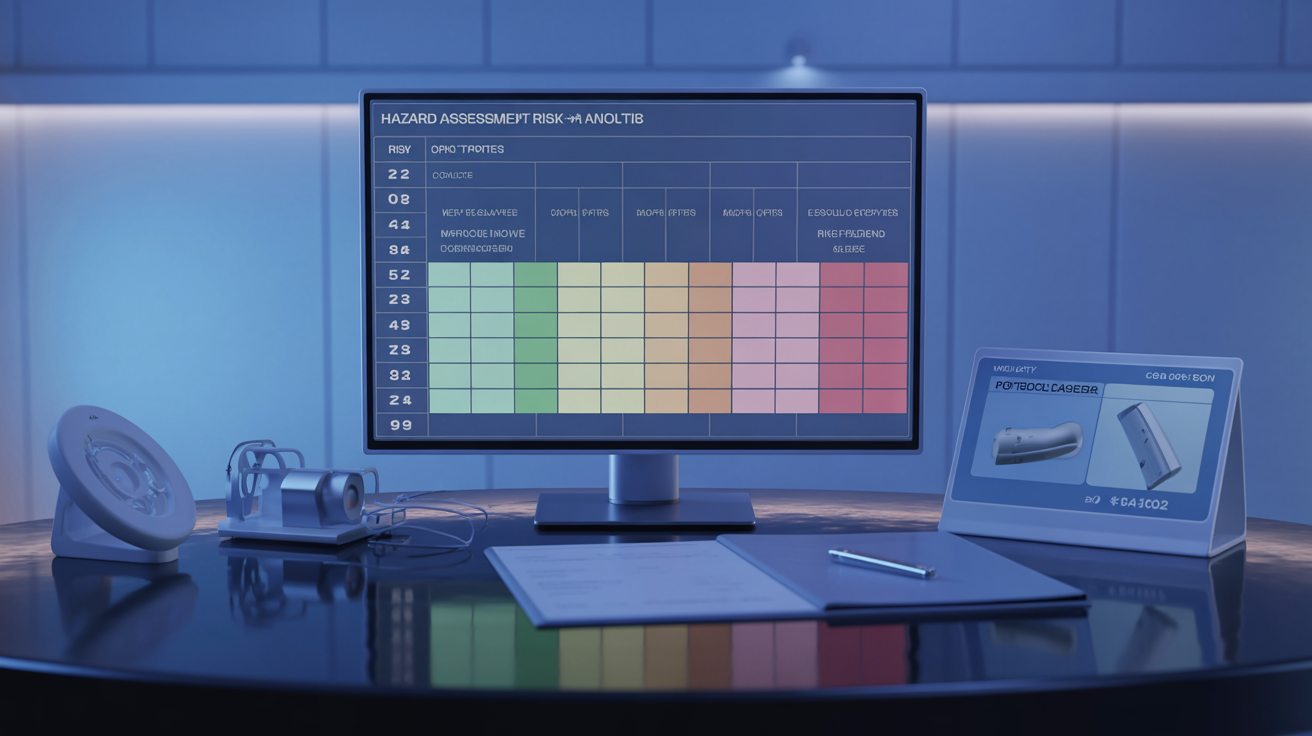
Risk management is the backbone of every medical device quality system. ISO 14971 defines the framework, but implementation is where companies struggle. We walk through the entire risk management process — from preliminary hazard analysis through risk estimation, evaluation, control measures, and residual risk assessment. Includes practical guidance on top-down vs. bottom-up analysis, severity/probability matrices, risk-benefit analysis for Class III devices, and how to maintain your risk management file through post-market surveillance.
Risk Management Foundation
ISO 14971 is the international standard for risk management of medical devices, required by both ISO 13485 and FDA regulations. It provides a systematic process for identifying hazards, estimating and evaluating risks, controlling risks, and monitoring the effectiveness of risk controls throughout the product lifecycle.
Risk management is not a one-time activity performed during design. It is a continuous process that begins with initial concept and continues through production, post-market surveillance, and eventual decommissioning. Your risk management file must evolve as new information emerges from manufacturing, customer feedback, and post-market experience.
The Risk Management Process
ISO 14971 defines a structured risk management process: risk analysis (hazard identification, risk estimation), risk evaluation (determining acceptability), risk control (implementing measures to reduce risk), and residual risk evaluation (assessing remaining risk after controls). Each step produces documented outputs that form your risk management file.
Hazard identification must be comprehensive — consider all reasonably foreseeable hazards including use errors, degradation, environmental factors, and interactions with other devices. Risk estimation combines probability of harm with severity of harm. Risk evaluation determines whether each risk is acceptable based on your defined criteria.
Integration With Design Controls
Risk management and design controls are deeply interconnected in medical device development. Risk analysis outputs inform design inputs — identified hazards generate safety requirements. Risk control measures become design features that must be verified and validated. Residual risks must be communicated through labeling and instructions for use.
The most effective implementation treats risk management and design controls as parallel processes that continuously inform each other. Design decisions affect risk. Risk analysis informs design decisions. This bidirectional relationship must be documented and maintained throughout the product lifecycle.
Common Pitfalls
The most common ISO 14971 implementation pitfalls include risk analysis that is too narrow in scope, risk evaluation criteria that are undefined or inconsistently applied, risk control measures that are not verified for effectiveness, and risk management files that are not updated with post-market data.
Another frequent issue is treating risk management as a regulatory checkbox rather than an engineering discipline. When risk management drives design decisions, it improves product safety. When it documents decisions already made, it adds cost without adding value. Build risk management into your development process from concept — do not retrofit it after design freeze.