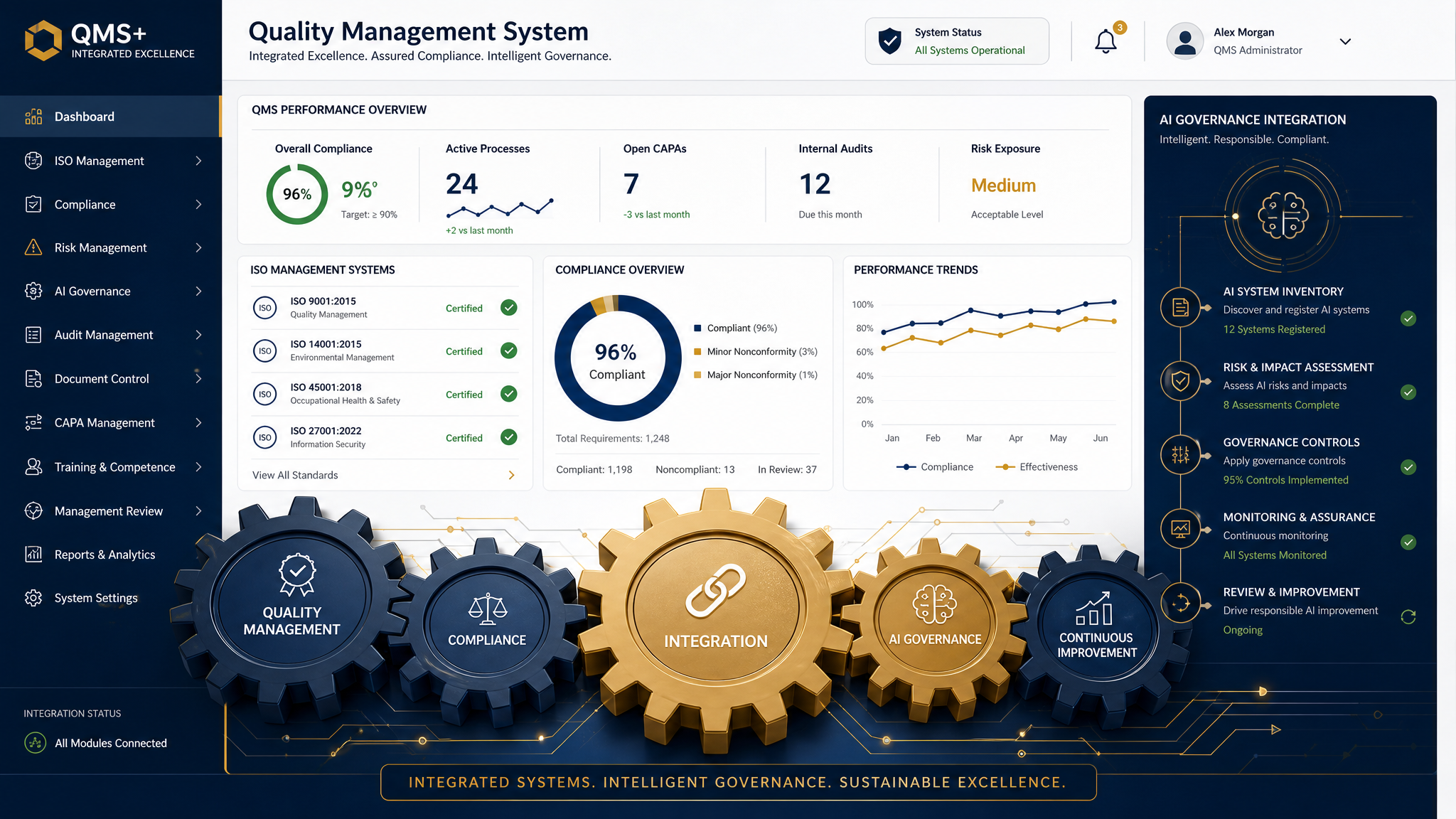
You already run ISO 9001. Maybe ISO 14001 or ISO 45001 too. Now ISO 42001 for AI management is here — and the good news is you do NOT need to build a standalone system. The Annex SL harmonized structure means AI governance slots directly into your existing management system framework. We show you exactly how to integrate AI risk assessments into your existing risk register, extend your document control to cover AI model versioning, adapt your internal audit program to include AI-specific checkpoints, and leverage your management review process to govern AI deployment decisions. One integrated system, not three separate ones.
Why Integration Beats Standalone
Manufacturers implementing AI governance face a choice: build a standalone AI governance program or integrate AI governance into their existing ISO management system. Integration is overwhelmingly the better approach for three reasons. First, it leverages existing processes rather than creating new ones. Second, it ensures AI governance receives the same management attention as quality and safety. Third, it avoids creating organizational silos between AI governance and operational management.
ISO 42001 was designed for integration. It follows the same Annex SL structure as ISO 9001, ISO 14001, ISO 27001, and ISO 45001. If you have any of these certifications, you already have the management system foundation that AI governance requires.
Integration Points
Specific integration points between AI governance and existing ISO management systems include policy and objectives where your quality policy expands to include AI governance commitments, risk assessment where your existing risk process incorporates AI-specific risks, competence and training where your training program adds AI literacy requirements, operational controls where your process controls extend to AI system management, and monitoring where your measurement program includes AI performance metrics.
Each integration point connects AI governance to processes your team already manages. This means AI governance becomes part of existing routines rather than creating new ones — dramatically improving adoption and sustainability.
Step-by-Step Implementation
Step 1: Conduct an AI inventory identifying all AI systems in your operations, their purposes, data sources, and decision authority levels. Step 2: Extend your risk assessment process to evaluate AI-specific risks including bias, model drift, data quality, and transparency. Step 3: Define AI-specific controls including human oversight requirements, performance thresholds, and fallback procedures.
Step 4: Update your training program to include AI literacy for relevant personnel. Step 5: Extend your internal audit program to cover AI governance processes. Step 6: Include AI performance in your management review agenda. Step 7: Document everything within your existing management system documentation structure.
Measuring AI Governance Maturity
AI governance maturity can be measured across five dimensions: coverage (what percentage of AI systems are governed), risk management (are AI risks assessed and controlled), monitoring (is AI performance continuously evaluated), transparency (can you explain AI decisions to stakeholders), and improvement (are you actively improving AI governance based on experience).
Track these dimensions and include them in management review reporting. As your AI governance matures, you should see increasing coverage, more sophisticated risk management, real-time monitoring, greater transparency capability, and evidence of governance improvements driven by operational experience.